After being rejected by Groupon, Google’s picked up their pride and has decided to do the group coupon thing on its own.
Yup, just like that, things are going to be a lot more interesting for current group buying leader Groupon.
First, the details on Google’s planned competitor.
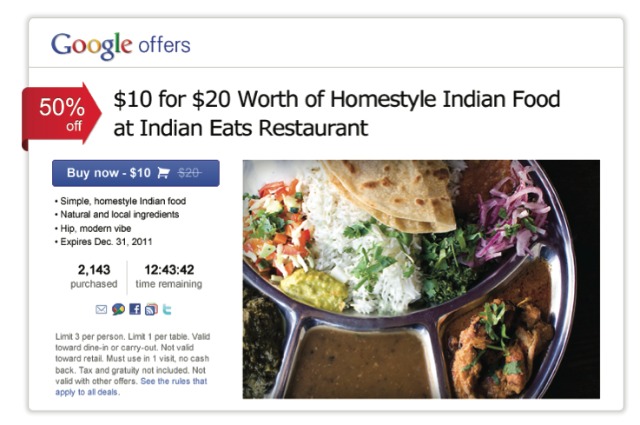
Image via Mashable
Mashable received a confidential fact sheet spelling out the merchant benefits of Google Offers, “a new product to help potential customers and clientele find great deals in their area through a daily email.” From the fact sheet, we learn that Google will provide writers to write up offers (just like Groupon), promote the offer on the Google Offers website and through email to local subscribers (just like Groupon).
Right now Living Social is Groupon’s closest competitor, and even with a national promotion that topped Groupon’s national promotion (their50% off Amazon giftcard deal ended up pulling in a little more than $13 million), they’re a distant second. Here’s why competition from Google will be unlike anything else that Groupon’s had to deal with so far:
1. Google knows Groupon’s secrets
Even though an acquisition never happened, Google surely had plenty of time during due diligence to examine Groupon’s operations inside and out. They know their strengths, but more important they know their weaknesses in a way that other copycats don’t.
2. Google knows a lot of Groupon’s secrets
Even beyond anything they learned in due diligence, Google runs what is arguably the largest ad network on the internet. Perhaps you’ve heard of a little product called AdWords, or a small acquisition that didhappen called DoubleClick. Google will offer some church and state separation assurance that they aren’t looking into specific advertisers campaigns, but let’s be honest – Google’s seen a lot of things on Groupon that they can’t unsee and we’re pretty sure that includes ad data.
3. Google made $8 billion last quarter
Groupon recently raised $1 billion and is rumored to be going for a $15 billion IPO. They also do approximately $2 billion per year in revenue – as much or more than Facebook pulled in, on a smaller user base. Google made $8 billion in one quarter. And they own millions of email addresses through Gmail. And they own the ad network that runs ads to those users. And they could afford to keep pace with Groupon’s spending, even if they didn’t.
Uh oh.
Lest we seem to be all doom and gloom about Groupon’s prospects, there are a few things to keep in mind. First is that the companies have different DNA, and if Google was willing to buy Groupon in spite of that – or perhaps even because of that, it’s a sign that email addresses and an advertising budget may not be the end all be all of dominating the space. As a company, Google is probably the smartest guy in the room but Groupon is the life of the party.
When it comes to local business, that may make a difference. When it comes to your search results, or your phone doing cool new things, you probably want the smartest guy in the room. When it comes to trying new things, you probably don’t want that guy telling you what’s fun, even if it’s algorithmically correct.
That life of the party, witty promotion is central to the type ofcommunity spirit that got users hooked on Groupon and the businesses they promote in the first place, and will be what keeps Groupon in the fight as much as billion dollar investments.


